A hierarchical planner-and-toolcaller design is sound. The part that decides whether it tells the truth is what one agent hands to the next.
Updated 4 October 2026: the reading of the paper's results was revised and expanded.
A scientist asked our research agent about a screening result and got back "no data." The data existed. A tool had compacted its own output and silently dropped every result family in which 0% of the measurements were positive, so the answer had nothing to say about them. "No data" and "0%" are very different findings, and the agent reported the wrong one.
The same investigation found more. A table of per-concentration rows arrived as unlabelled positional arrays that kept only the top similarity score, and the model read it as "inactive at all concentrations" when one concentration was clearly active. The single agent had actually written the correct report, but a grounding check blocked it, because the check only saw this turn's tool results. The turn escalated into the multi-agent pipeline, where the first stage rebuilt the request from a short slice of chat history, invented one compound identifier (think CMPD-0001 appearing from nowhere), dropped another, and passed a flag that skipped the tool's own identifier validation. The reviewer, which saw only the previous stage's prose, passed all of it.
Every one of those failures came from a stage working from a lossy copy of what came before it: a compacted result, an unlabelled array, one turn of evidence, a short slice of history, another agent's prose. Each stage had something to trust and nothing to check it against.
Around the same time I read a short July 2025 paper, Agent-as-Tool: A Study on the Hierarchical Decision Making with Reinforcement Learning (Yanfei Zhang, arXiv 2507.01489), that gives this architecture a name and makes a clean argument for it. This post is about what the paper proposes, how much its evidence supports, and the design decision where our production system went the other way: what, exactly, a reasoning agent should receive from an agent that holds the tools.
The paper splits a question-answering agent into two parts. A Planner does the reasoning: it thinks in a <think> block, then emits a sub-query inside <tool_calling> tags. A Toolcaller is a separate chat agent (a CAMEL-style agent on GPT-4o-mini) that owns the web-search tool. It takes the Planner's query, runs the search, possibly several times, and returns a processed observation in <obs> tags. The Planner reads that observation and either asks again or answers. The claim is that a reasoner works better on a cleaned, structured observation than on raw search snippets full of unrelated symbols and details.
The paper's own example shows the idea well. The question asks where the mother of Ernst I, Prince of Hohenlohe-Langenburg, was born. The Search-R1 baseline reads raw snippets, sees a passage saying the prince married Princess Feodora of Leiningen, takes the wife for the mother, and answers with Feodora's birthplace, Amorbach. The hierarchical version asks the Toolcaller who the mother is, gets back a short observation naming Countess Amalie Henriette of Solms-Baruth, asks where she was born, and answers correctly: Kliczków.
The Planner is a Qwen-2.5-7B-Instruct model trained with GRPO, the group-relative policy-gradient method from the DeepSeekMath paper (this paper spells the acronym out as "Generalized Reinforcement Policy Optimization"). Training is deliberately tiny: 60 steps, each with 3 questions and 12 rollouts per question, which is 180 training questions and 2,160 rollouts, drawn from HotpotQA and 2WikiMultiHopQA, with at most 10 rounds of tool calling per rollout. The reward is the answer's F1 score if the output is well formatted and −2 otherwise. One detail matters for the rest of this post: the paper applies observation masking, replacing the <obs> spans with a padding token when it computes rewards and trains, so the Planner is neither credited nor penalised for text the Toolcaller wrote. That is a training-time device for what the paper calls credit assignment. It does not hide anything from the Planner when it answers, and I come back to why that distinction matters in the hand-off section below.
The abstract reports 63.2% exact match and 75.2% cover exact match on Bamboogle, beating Search-R1 by 4.8 and 3.2 points. Those numbers are in the tables. So is the rest of the picture, and a fair reading needs all of it. Here are the rows of Table 1 that matter, as exact match / cover exact match, with the best score in the paper's table for each dataset and metric in bold:
| Dataset | CAMEL + web search (one GPT-4o-mini agent) | Search-R1 + web search | Agent-as-tool, before RL | Agent-as-tool, after RL |
|---|---|---|---|---|
| Bamboogle | 51.2 / 62.4 | 58.4 / 72.0 | 60.0 / 71.2 | 63.2 / 75.2 |
| HotpotQA | 32.4 / 59.4 | 47.2 / 64.2 | 35.0 / 55.2 | 37.2 / 57.4 |
| 2WikiMultiHopQA | 35.0 / 69.4 | 52.4 / 68.0 | 42.8 / 68.0 | 44.6 / 70.0 |
| MuSiQue | 16.0 / 29.4 | 20.8 / 28.6 | 15.6 / 28.8 | 18.4 / 29.8 |
The paper calls the two hierarchical rows "Base" and "Instruct"; both are Qwen-2.5-7B-Instruct, before and after RL. I have left out three weaker baselines.
On exact match the hierarchy trails Search-R1 on three of the four datasets, by 10.0 points on HotpotQA, 7.8 on 2WikiMultiHopQA and 2.4 on MuSiQue. The headline win is Bamboogle, and only Bamboogle; the paper's own text says Search-R1 keeps the best exact-match score on the other three.
Cover exact match needs a closer look. It counts an answer as correct if it contains the gold string, which rewards longer answers more easily, so a gap in it is weaker evidence than the same gap in exact match. The paper calls its cover-exact-match results a substantial improvement over all the baselines except on HotpotQA. Against the best baseline on each dataset, the margins are 3.2 points on Bamboogle, 0.6 on 2WikiMultiHopQA and 0.4 on MuSiQue, the last two against the single-agent CAMEL baseline rather than Search-R1. On HotpotQA, CAMEL beats it too (59.4 against 57.4).
The benchmarks are also small. Bamboogle has 125 questions, and its authors designed it to measure compositional question answering "albeit with less statistical power". Every Bamboogle score in the paper is a multiple of 0.8, one question's worth, so the paper appears to use all of them (it does not state its test-set sizes). The 4.8-point margin over Search-R1 is then six questions, and the 3.2-point gain from RL is four. The other datasets' scores are all multiples of 0.2, which fits 500-question samples, where the 0.6- and 0.4-point margins would be three questions and two. On a paired exact (McNemar) test, the six-question margin clears the usual 5% bar only if Search-R1 got no question right that the hierarchy missed (p ≈ 0.03; with one such question, p ≈ 0.07), and the four-question RL gain cannot clear it whatever the overlap. The paper reports no significance tests, repeated runs or per-question results, so readers cannot check.
Where does the gain come from? It depends on the baseline. The CAMEL baseline with web search is one GPT-4o-mini agent calling search directly: in effect, the Toolcaller answering the whole question alone, so it shows what the 7B Planner adds. On Bamboogle, most of that is present before any RL (51.2 exact match for CAMEL, 60.0 untrained, 63.2 after RL). On the other three datasets, CAMEL's cover exact match is within two points of the trained hierarchy's, and ahead on HotpotQA, while its exact match is 2.4 to 9.6 points lower. Its answers contain the gold string about as often; they state it in exactly the expected form less often. Outside Bamboogle, then, much of the Planner's exact-match lead looks like answer form rather than answers found. The paper says both hierarchical versions improve substantially on this baseline in both metrics; on cover exact match, the untrained one is below it on three of the four datasets. The same reading cuts the other way for Search-R1, which was trained with an exact-match reward: on 2WikiMultiHopQA and MuSiQue its exact-match lead over the hierarchy (7.8 and 2.4 points) becomes a cover-exact-match deficit (2.0 and 1.2 points). Only on HotpotQA does Search-R1 lead on both metrics.
Against Search-R1, the untrained hierarchy is only 1.6 points ahead on Bamboogle exact match and 0.8 behind on cover exact match, so RL supplies 3.2 of the 4.8-point margin. The setup also adds a second model, GPT-4o-mini, that reads search results for a 7B planner, and Search-R1 has no such reader, and it is off its home ground here: it was trained on NQ and HotpotQA against a local 2018 Wikipedia index returning three passages, not on live web search, and HotpotQA, the one dataset where it leads on both metrics, is one of its training sets. In the paper's no-search rows, GPT-4o-mini beats the 7B model on cover exact match on every dataset and on exact match on three of the four, and the paper's own example is a misread raw snippet fixed by a different model doing the reading. Part of the gain may come from the stronger reader rather than from the hierarchy. There is no ablation that separates the two, and no count of searches per system, so there is no way to tell whether search budget was matched either.
The training curves are modest too. The Figure 2 caption reports the loss stabilising after about 30 steps, but a policy-gradient loss is not a measure of how well the model is doing; the reward curve is the one to read. It moves mostly between about −1.5 and −0.75, averaging about −1.2 over the first 30 steps and −1.1 over the last 30, with no clear upward trend. Its scale says more. A well-formatted answer scores between 0 and 1 and a malformed one −2, so, if the plotted value is the plain average of that reward, a step averages below −1 only if more than half its rollouts were malformed, and most steps do. In any group of 12 rollouts that mixes the two, the format penalty outweighs any difference in answer quality, so much of the signal in those 60 steps was probably about format. The gains may not be only formatting, but with no format-error rates reported, the two cannot be separated.
My read: the architectural idea is sound and well motivated, and the Bamboogle result is a reasonable first signal, but only that: a six-question margin on one small benchmark, with no repeated runs and no ablation that separates the hierarchy from the stronger reader. The reinforcement-learning evidence is thin, which the paper's own scale (180 questions, one small model) makes unsurprising, though it does point one way: Table 2's gains are positive in all eight dataset-and-metric cells, from +1.0 to +4.0 points. The useful thing to take from it is the separation of concerns, and the interesting engineering question is what the interface between the two halves should carry.
Our research agent is a four-stage pipeline described in an earlier post, so here is only the shape. Fixed rules route explicit research requests to the pipeline and identity or inventory questions to a single agent. For everything else a small classifier model (Haiku 4.5, a few output tokens, temperature zero) chooses, defaulting to the pipeline when uncertain. The pipeline then runs a Scout (Sonnet 5.5, the main retriever, holding the data tools), an Analyst (Sonnet 5.5, statistics and scripts), a Synthesizer (Opus 5.5, writes the answer) and a Critic (Opus 5.5, reviews it). Each stage is its own HTTP service behind a circuit breaker, and state-changing actions are blocked by a before-tool-call hook until the Critic has reviewed the draft.
The Scout is the closest thing we have to the paper's Toolcaller. But the map is not clean. Several stages hold tools: the Analyst has its own, the Synthesizer has a few, and the Critic can run its own knowledge-graph and literature checks, which are merged into the evidence tagged as the reviewer's. There is no pure Planner that only thinks and no pure Toolcaller that only fetches. The useful comparison is not a stage-for-stage match but the interface: what crosses each boundary.
The paper's instinct, that a reasoner should not drown in noise, shows up in several places in our design, each a deliberate limit on what a stage sees.
Each is a decision about what a stage does not need to see, in the spirit of the paper's view that cleaner inputs help reasoning.
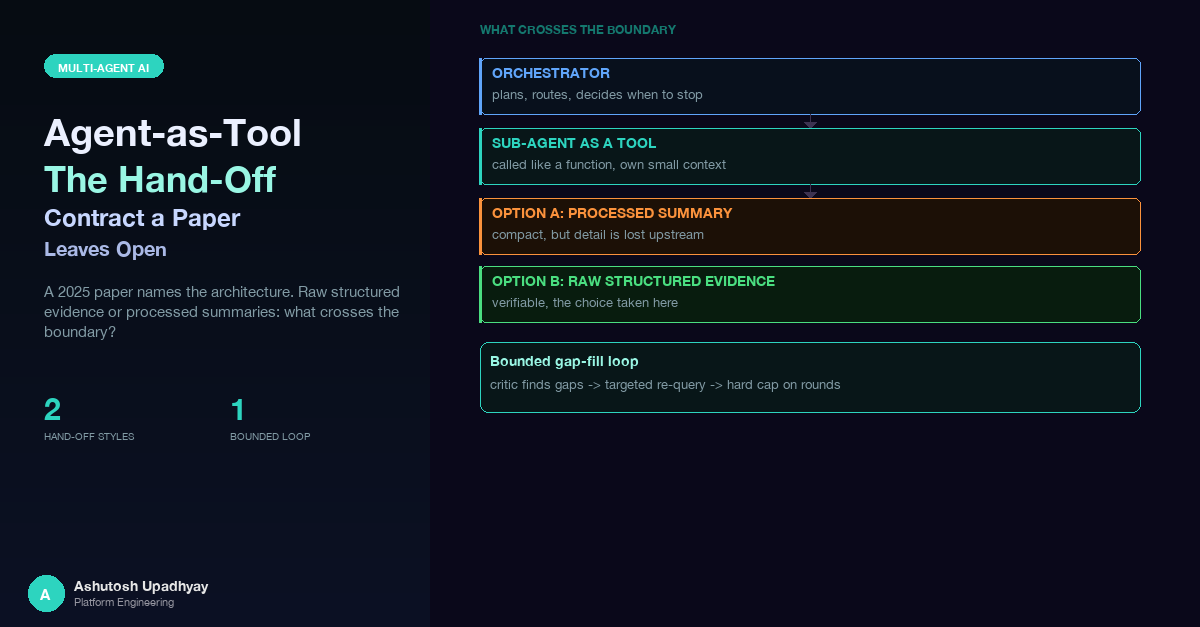
Here is the design choice the paper leaves open. In the paper, the Toolcaller returns processed observations: its own summary of what the search returned. The Planner never sees the raw snippets. In the paper's own example, the observation that settles the first hop is one sentence naming the mother, plus a link.
This is where the masking detail from earlier matters. Observation masking changes what the Planner is trained on, not what it reads when it answers. When the Planner answers, the summary is everything it knows about the search. It can ask again, but every answer it gets back is another summary, and nothing in the architecture checks a summary against the evidence behind it. For web search, where results are noisy and the end product is a short factual answer, that is a sensible trade. For a research agent whose answers are tables, counts and statistics that a scientist will act on, a summary is a lossy, unverifiable layer. Every failure in the cold open came from a stage working from a lossy copy.
So the Scout's contract is not "return an answer." It is "return evidence." Its prompt tells it to return raw data and not to summarise it. And every sub-agent now returns the same three things: its text, the list of tools it called, and a list of structured tool results. Each result entry carries:
{
  "tool": "query_assay_results",
  "input": {"compound": "CMPD-0001", "limit": 500},
  "output": "...",
  "status": "success",
  "truncated": false,
  "output_truncated": false,
  "ids_never_seen": [],
  "stored_ref": null
}
Error results are kept, not dropped. An empty or failed call is evidence too, and a reviewer who cannot see that a source was tried and failed cannot tell it from a source nobody tried. A fixed character budget for the whole set of results is split evenly across calls with a floor per call, so a single large result cannot starve the others (the mechanics of in-flight accumulation are in an earlier post). The Analyst receives the full Scout result, and the Synthesizer receives it too, apart from the prose cut above. The Critic receives the uncut Scout result, the Analyst's result, the user's prompts and earlier turns' tool results.
Here is how that compares with where we started:
| Before | After | |
|---|---|---|
| What a stage captured | Tool name and result only | Tool, input, output, status, truncation flags, identifiers never seen, stored-result pointer |
| Errors | Dropped | Kept |
| What the Critic saw | The Scout's prose | Structured results with inputs, plus the prose |
| What the Synthesizer saw | The Scout's prose | Structured results with inputs, plus the prose |
| Review material | The prose alone | Tool skills attached automatically when exactly one skill is linked to a tool, plus per-tool review checklists |
I would describe the change as moving from processed summaries toward raw structured evidence: the stage that holds the tools returns evidence, and the stages that reason get both its prose and the structured results. The prose is still useful, since it is where the Scout notes what looked odd. It just stops being the only thing the reviewer can check.
One rule in the Scout's prompt does a lot of work. In paraphrase: use the true total for every count, never the number of rows that happened to be inline; and pass through the download link, the true total, the truncation flag, any export error and any notes verbatim, at the very top of the output, before any table or summary. The Synthesizer's prompt carries the matching rule. We added the Synthesizer half first, and an advisor review pointed out that it could never fire: at the time the Synthesizer saw only the Scout's prose, so a link the Scout had paraphrased, or left below a table that the prose cut removed, never reached it. A rule about a value is only as good as the hand-off that delivers the value intact. This is also where large results go: anything too big to inline is exported by reference, and the true total travels with it (the counter-is-not-a-count trap is covered in this post).
A related hand-off is settings. A stored skill, written for a different client, told the model to always switch a certain option on. The tool hardcoded it off. The agent's reply reported the option as on, because the model trusted the skill text it had read and not the request the tool actually sent. The fix has four parts: the tool echoes the settings it effectively applied, the deterministic report renders what was sent, every prompt that can answer carries the rule "state settings only from the tool result", and a post-deploy check compares what the report says with what was sent. The lesson generalises. Whenever a tool and its documentation can drift, the tool's own echo is the only evidence a reviewer can rely on.
In the paper, the Planner can loop: think, call the Toolcaller, read the observation, repeat, up to a limit of ten rounds. Our pipeline for a long time had no such loop. A Critic verdict of "needs revision" re-ran only the Synthesizer, on the same evidence. If the Critic said a source was available but never queried, the revision could not fetch it, because the writer holds no retrieval loop and the Scout had already finished.
We measured how often that mattered. Across a sample of Critic reviews, roughly a quarter to 30% named a source that was available and never queried.
The gap-fill loop closes this, with bounds instead of an open-ended cycle:
The Analyst is not re-run; the revision works from the merged evidence. The flag for this loop is on in production. The point here is the shape: the paper's loop bound is a count of tool rounds, and ours is a count of gaps, a time budget and a single re-review, which fits a pipeline where each round is a multi-minute service call.
When the first failure landed, the tempting fixes were all specific to the tool that failed. We rejected them, and the reason is a design principle worth stating: the platform is agentic, so the fix should be to give the agents the facts they lacked, not to add rules that approximate judgment. The question for any agent-quality bug is which fact the agent was missing (data it never saw, context that was lost, a reviewer checking prose and not data), and whether a fix at that level helps every tool.
Three rejected options illustrate it:
What shipped instead was platform-wide: the classifier sees recent turns, structured results go to the Synthesizer and the Critic, writes happen only after review, the first stage and escalations get real session context plus a digest of earlier tool calls, and the grounding check sees earlier turns' tool results. The tool-level data fixes stayed, because they are correctness and not routing: every result family kept, labelled columns, sorting, missing identifiers reported, and the tool validating its own inputs.
| Agent-as-tool (paper) | Our research pipeline | |
|---|---|---|
| Who reasons | A trained 7B Planner | Synthesizer and Critic on Opus 5.5, with the Analyst on Sonnet 5.5 for statistics |
| Who retrieves | A Toolcaller agent that wraps web search | The Scout is the main retriever; the Analyst, Synthesizer and Critic hold a few tools of their own |
| What the reasoner sees | The Toolcaller's processed observations | Raw structured evidence plus the Scout's prose |
| Training | GRPO on the Planner, 180 questions | Prompt and skill changes; no model training |
| Verification | None in the architecture | An adversarial Critic that sees the evidence |
| Loop bound | Up to 10 rounds of tool calling | At most 3 gaps, one re-review, a time budget, no second loop |
The paper closes with a direction I find the most interesting part: making the Planner a tool orchestrator that decides dynamically which agent or tool to assign, instead of a fixed assignment. Our routing is still largely fixed: rules, a small classifier, and a pipeline order that is the same for every research question.
The natural next step is outcome-driven orchestration, where the choice of which sub-agent or tool to involve comes from accumulated Critic verdicts and not from a hand-written table. For each kind of question, which stages added value, which gaps the Critic kept finding, which routes produced a clean pass on the first review?
The paper's tool for learning decisions like these is reinforcement learning, and there is a practical constraint on copying it. The Claude models we run cannot be RL-tuned on Amazon Bedrock: at the time of writing, Bedrock's reinforcement fine-tuning supports Amazon Nova 2 Lite, OpenAI's gpt-oss-20B and Qwen3 32B. That is a design constraint, not a complaint, and it points at what we do have. Reviewer verdicts are a structured, per-stage training signal that arrives for free with every answer. Used to tune routing rules and prompts, and measured per path against a baseline, they give a feedback loop that does not need gradient updates. The Critic would stop being only a gate at the end and start informing where the next question goes.
Disclaimer: The views and opinions expressed in this post are my own and do not represent those of my employer or any organisation I am associated with.