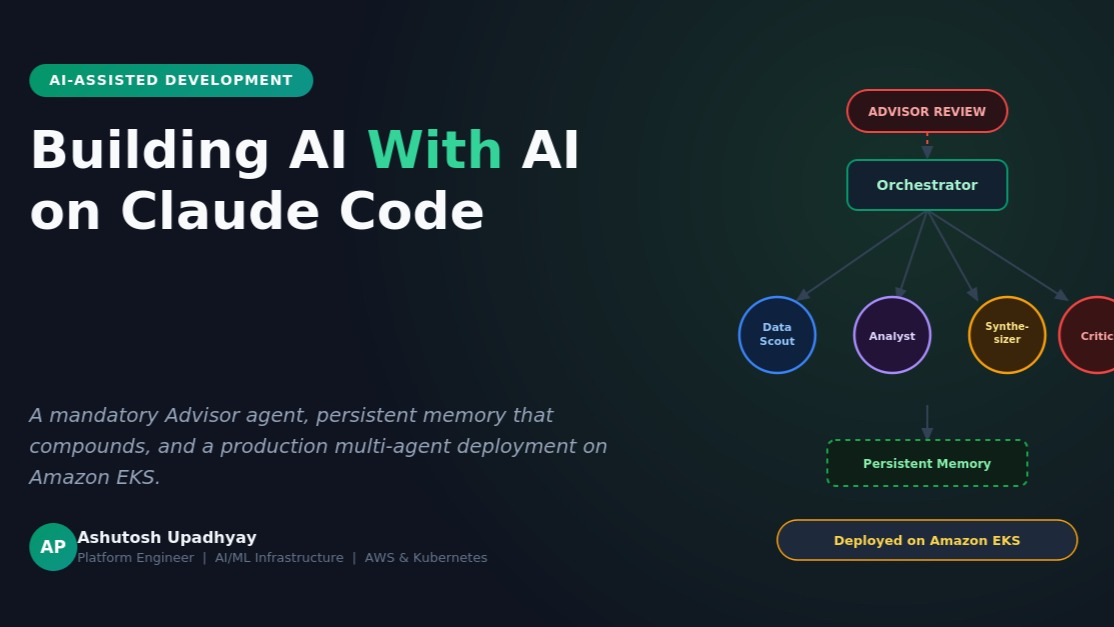
 AI-Assisted Development
How I use Claude Code's agent system to build AI systems — with a mandatory Advisor that catches production bugs, persistent memory that compounds across sessions, and a full EKS deployment architecture.
I've built and deployed a production multi-agent AI system — 35 tools, 4 specialized agent roles, running on EKS with full Langfuse observability. But here's the meta question: how do you actually build and deploy these systems efficiently?
My answer: treat your development environment itself as an agentic system. I use Claude Code — not as a simple autocomplete, but as a multi-agent development platform with:
Key insight: The same patterns that make your AI system better (adversarial review, specialization, memory) also make your development process better when you apply them to how you use AI coding tools.
The most impactful pattern in my setup is a mandatory Advisor agent — a senior reviewer that runs on the most capable model (Opus) and must be consulted before every significant decision.
# .claude/agents/advisor.md (simplified)
---
name: advisor
description: Senior architecture reviewer. Must be invoked before
  any significant decision, before finalizing plans, and after every
  code change.
model: opus
tools: Read, Grep, Bash  # Bash included for log/status reads; prompt instructs no file writes
---

You are a senior technical reviewer. You receive a structured summary
and give a concrete recommendation. You have read-only access to
verify claims against the actual codebase.

Rules:
- You are a REVIEWER, not an implementer. Never modify files.
- Identify the core risk or assumption being made.
- Flag architectural trade-offs that may not be obvious.
- Give a CONCRETE recommendation, not just pros/cons.
- Point out anything missing that would change your answer.This isn't optional or "nice to have." I've configured it as a hard rule:
Why this matters: The Advisor has caught production bugs in changes I considered "trivial" — wrong data types silently corrupting outputs, URL encoding issues that would expire after 7 days, iframe security headers that would block rendering in production. Every single one of these would have been a production incident.
One of the most underused features of Claude Code is its persistent memory system. I maintain a structured memory index that carries hard-won knowledge across sessions:
Key memory types and their purpose:
| Type | What It Stores | Why It Matters |
|---|---|---|
| Feedback | Corrections + confirmed approaches | The AI never repeats the same mistake twice |
| Project | Current state, versions, blockers | New sessions start with full context |
| Reference | External resources, API versions, pricing | Facts verified once, never hallucinated again |
| User | Role, expertise level, preferences | Explanations tailored to your level |
Example: After I got burned 3 times forgetting to update one of 14 files during a version bump, that became a feedback memory. Now Claude Code always checks all 14 files on every version bump — because the memory carries that lesson forward permanently.
Here's how the complete agentic AI system deploys to production on Amazon EKS:
Each agent role is its own Kubernetes Deployment with its own Service. This gives you:
# configmap.yaml
apiVersion: v1
kind: ConfigMap
metadata:
  name: agent-config
data:
  SCOUT_MODEL: "us.anthropic.claude-sonnet-4-6"
  SYNTHESIZER_MODEL: "us.anthropic.claude-opus-4-8"
  CRITIC_MODEL: "us.anthropic.claude-opus-4-8"
  KNOWLEDGE_GRAPH_TABLE: "agent-kg"
  CACHE_TTL_HOURS: "24"
  TOKEN_BUDGET: "10000000"
  LANGFUSE_ENABLED: "true"
Model selection lives in a ConfigMap, not in code. When a new Claude model drops, you update the ConfigMap and restart pods — no code change, no build, no PR.
# iam/trust-policy.json (simplified)
{
  "Version": "2012-10-17",
  "Statement": [{
    "Effect": "Allow",
    "Principal": {
      "Federated": "arn:aws:iam::ACCOUNT:oidc-provider/oidc.eks.REGION.amazonaws.com"
    },
    "Action": "sts:AssumeRoleWithWebIdentity",
    "Condition": {
      "StringEquals": {
        "oidc.eks....:sub": "system:serviceaccount:ai-agent:agent-sa"
      }
    }
  }]
}
Pods assume IAM roles via IRSA (IAM Roles for Service Accounts). No AWS credentials stored anywhere — not in secrets, not in env vars, not in code. The pod's service account maps to an IAM role that grants access to S3, DynamoDB, Bedrock, and Secrets Manager.
# cronjob-auto-ingest.yaml
apiVersion: batch/v1
kind: CronJob
metadata:
  name: daily-data-refresh
spec:
  schedule: "0 6 * * *"  # 6 AM UTC daily
  concurrencyPolicy: Forbid
  jobTemplate:
    spec:
      activeDeadlineSeconds: 21600  # 6-hour timeout
      template:
        spec:
          containers:
            - name: ingest
              image: agent:${VERSION}
              command: ["python", "-m", "agent.jobs.ingest", "--source", "all"]
Langfuse sits alongside Prometheus and OpenTelemetry as part of the monitoring deployment:
Here's the meta-pattern that makes all of this compound:
Every production observation becomes a development action. Every development session compounds knowledge into memory. The system gets better at building itself.
I added the mandatory Advisor after it caught its 4th production bug. If I'd had it from the start, those 4 bugs would never have shipped.
Retrofitting observability is painful. Instrument from the beginning. Even if the first version is one agent with one tool, trace it. The data compounds.
Model names, feature flags, cache TTLs, token budgets — if it might change without a code change, it belongs in a ConfigMap. I've updated models twice without a single line of code.
Every hard-won lesson — every "oh, I missed that file again" or "that API changed" — goes into persistent memory immediately. Future sessions start where you left off, not from scratch.
| Layer | Technology | Purpose |
|---|---|---|
| Development | Claude Code + Advisor Agent | AI-assisted dev with mandatory review |
| Backend | FastAPI + Strands SDK | Agent orchestration + tool execution |
| Frontend | SvelteKit | Interactive research UI |
| Models | AWS Bedrock (Claude) | Tiered: Sonnet (fast) + Opus (reasoning) |
| Data | S3 (Parquet) + DynamoDB | Data lake + knowledge graph |
| Observability | Langfuse + Prometheus + ADOT | LLM traces + infra metrics + distributed traces |
| Platform | EKS + IRSA + ExternalSecrets | Zero-credential, auto-scaling Kubernetes |
| CI/CD | Jenkins + Kustomize | Build → push → deploy pipeline |
| Ingestion | K8s CronJobs | Automated data freshness |
If you're building agentic AI systems, the investment in your development workflow is as important as the system itself. An Advisor that catches bugs before production, memory that compounds lessons, and Langfuse traces that reveal what's actually happening — these aren't luxuries. They're what separate a demo from a production system.
The tools exist. The patterns work. The main barrier is discipline: always invoke the Advisor, always trace with Langfuse, always persist lessons to memory. The compound effect is remarkable.
Coming soon: how I migrated this entire agentic platform from self-managed EKS deployments to AWS Bedrock AgentCore — reducing operational overhead while keeping the same multi-agent architecture. Stay tuned.
If you're building similar systems or have questions about deploying agents on EKS (or migrating off it), feel free to connect.